
Santa Fe Wood Flooring handles hardwood floor repair in Santa Fe, NM, serving surrounding cities including Agua Fria, La Cienega, Eldorado at Santa Fe, Valencia and Lamy. With 20+ years of repairing floors, we fix the problems that dry air, water, pets and old heating systems leave behind, and we weave the new wood into the old so the repair does not read as a patch.
Most repair calls start with a symptom: a gap, a crack, a squeak, a dark stain or a hole where a floor furnace used to sit. The symptom is where we start, but the diagnosis is what decides the fix. A gap from dry air and a gap from a failing subfloor look the same from across the room, and they need completely different repairs.
So every repair visit includes moisture readings in the boards and the room, a look underneath where there is access, and a written recommendation. Where the cause is humidity rather than damage, we will tell you that before quoting a repair you do not need.
Gaps, Cracks and Squeaks in Hardwood Floors
Seasonal Board Gaps in a Dry House
When indoor air dries out in the heating season, wood gives up moisture and each board narrows slightly. Across a room of narrow strips, those small changes add up to visible gaps. In spring, when the air holds more moisture again, the gaps usually close.
That pattern is normal wood behavior, not a defect. The repair is humidity control, and we write an indoor humidity target for the house. Where gaps stay open all year in an old floor, we fill them with thin wood slivers glued to one side of each gap, which moves with the floor instead of crumbling out.
Checking and Split Boards
Checking is fine surface cracking along the grain, caused when the face of a board dries faster than the core. Left alone in very dry conditions, a check can deepen into a split that runs through the board. Wide boards and wide plank pine are the most prone.
We sort boards into those that only need sanding and refinishing and those that need replacing. A board split through its thickness is replaced, because it will keep opening and can catch a sock or a bare foot.
Squeaks and Loose Boards
Squeaks come from wood rubbing on wood or on a fastener. When boards shrink in dry air, they loosen on their nails, and a floor that was silent in summer starts to squeak in winter. Squeaks that stay year-round usually point to a loose subfloor panel or a gap between the subfloor and a floor joist.
From below, we shim and screw the subfloor to the joist. From above, we use a specialty screw system that pulls the boards down and breaks off below the surface. Neither works for long if the floor is too dry, so we fix the humidity alongside the squeak.
Board Replacement and Weave-In Repairs
Cutting Out Damaged Boards
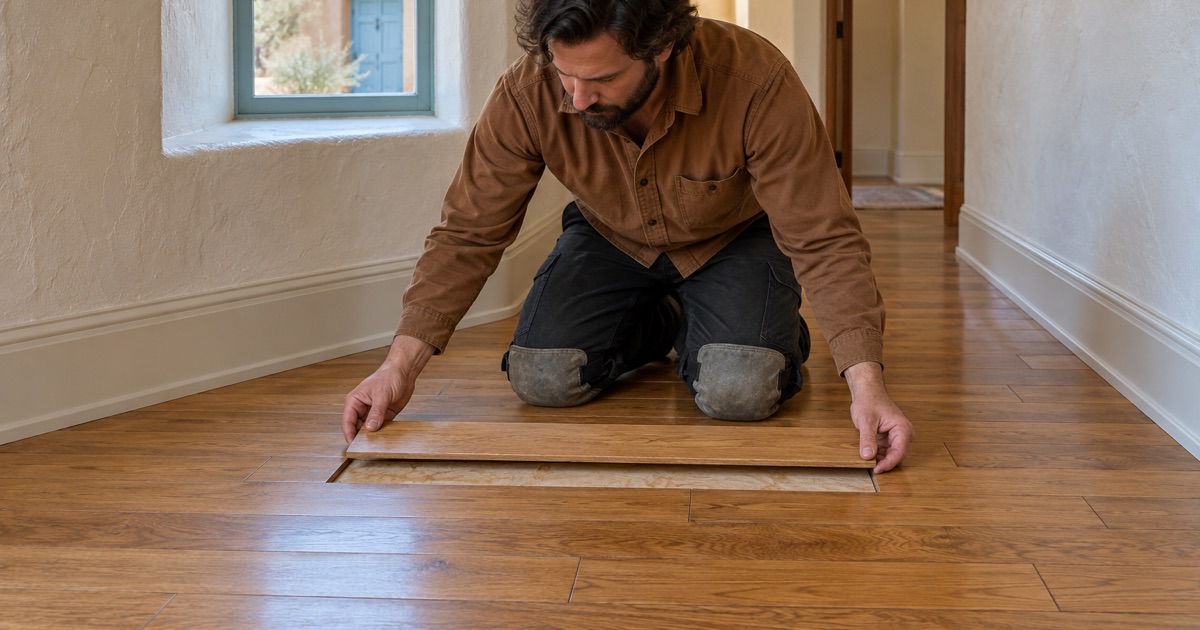
A damaged board is cut out along its length with a plunge cut down the center, then the pieces are pried out without disturbing the tongue and groove of its neighbors. The replacement board has its bottom groove lip removed so it can drop into place and is glued and fastened.
This is slow, careful work, and it is the difference between a repair that holds and one that shows a raised edge or a gap along one side within a season.
Matching Species, Width and Color
The repair is only as good as the match. We identify the species, measure the width and thickness and note whether the floor is red oak, white oak, maple, pine or something less common. Older floors are often a slightly different width from modern stock, so we measure before ordering.
For the best color match, we look for salvaged boards from inside the same house, such as a closet floor that will be covered, and replace those with new stock where nobody will see it.
Weave-In Repair Versus a Straight Patch
A straight patch cuts a square hole and fills it, leaving four straight seams that the eye picks up instantly. A weave-in repair staggers the ends of the replacement boards so they interlace with the existing rows, the way the original floor was laid.
The weave-in takes longer and uses more boards, but once it is sanded and finished with the surrounding floor, it disappears. That is the standard we hold every board replacement to.
Patching Floor Furnace and Wall Heater Openings
Framing the Old Heater Opening
Many older houses in and around Santa Fe were heated by a floor furnace set into a framed opening in the floor, or by a wall heater with a vent through the floor. When the heater was removed, the hole was often covered with plywood and carpet. When the carpet comes up, the patch is the first thing you see.
We remove the old cover, check the framing and the joists around the opening, and add blocking so the new boards are supported at their ends. A patch nailed over an unsupported opening sags and squeaks.
Sourcing Boards for Older Floors
Allen Stamm built several thousand homes in and around Santa Fe from 1939 to 1980, and descriptions of those houses mention hardwood floors. Many of the floor furnace patches we see are in houses from that era, where the original boards are narrow oak strip that is still available in close widths.
Where the original floor is an unusual width or species, we plan the weave-in around salvaged boards and use new stock only in places that will be covered. A closet floor or the strip under a built-in cabinet is often the best source of matching wood in the house.
Blending the Patch With a Refinish
Even perfectly matched boards look new until they are sanded and finished with the floor around them. For a furnace patch in the middle of a room, we usually recommend refinishing the room at the same time, so the color and sheen tie together.
If you want to keep the existing finish, we can sand and finish the repair area alone and feather it into the surrounding floor, and we will show you honestly how close that is likely to get before you decide.
Stains, Buckling and Damaged Edges
Pet Stains and Black Water Marks
Black marks around plant pots, pet bowls and doors are usually water that has reacted with the tannins in oak. Pet urine does the same and goes deeper. Surface gray may sand out; black that has soaked into the grain usually will not.
We test the depth of each stain and decide between sanding, bleaching and board replacement. Board replacement is often the most reliable answer, and done as a weave-in it leaves no trace.
Buckled or Lifted Boards
Boards that lift or buckle upward have taken on so much moisture that they have run out of room to expand. A leak, a wet slab, or a floor laid tight to the walls without an expansion gap are the usual causes.
We find and stop the moisture source first, let the floor dry and measure it, then decide how much can be flattened and how much has to be replaced. Buckling caused by a missing expansion gap is fixed by cutting the gap in along the walls, not just by replacing boards.
Damaged Edges at Tile, Brick and Flagstone
Where wood meets Saltillo tile, brick or flagstone, the edge of the wood often takes a beating: chipped finish, crushed board ends and gaps where the transition was never finished properly. These are small repairs that make a large difference to how a doorway looks.
We replace damaged board ends, fit a reducer strip or T-molding where the heights differ, and leave the expansion gap the wood needs, so the edge does not break down again in a year.
- 20+ Years Experience
- Written Moisture Readings
- Itemized Written Estimates