
Santa Fe Wood Flooring handles subfloor repair in Santa Fe, NM, serving surrounding cities including Agua Fria, La Cienega, Eldorado at Santa Fe, Valencia and Lamy. With 20+ years of installing and repairing wood floors, we know the finished floor is only as good as the layer beneath it, and many floor problems that look like bad boards are really a subfloor giving way.
Subfloor repair covers soft spots, rotted panels around plumbing, squeaks that no amount of surface work fixes, and humps or dips that make a new floor impossible to lay flat. It also covers preparing a concrete slab so an engineered floor can be glued down over it.
We open up only as much as the diagnosis requires, check the joists as well as the panels, and repair the subfloor so the flooring above it stays tight, flat and quiet for the long term.
Signs the Subfloor Is the Problem
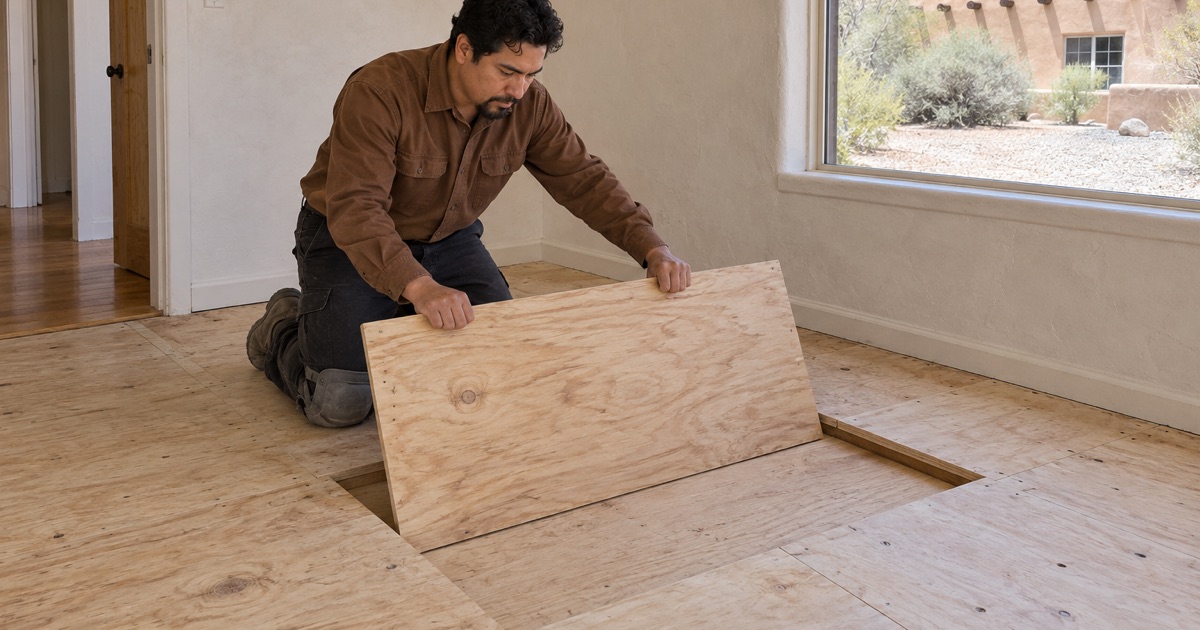
Soft or Spongy Spots
A spot that gives underfoot, especially near a bathroom, kitchen or exterior door, is the clearest sign of subfloor damage. It usually means the panel has been wet and has lost its strength, or that it has separated from the joist below.
We probe the area from below where there is access, and lift a board or two from above where there is not, so we know the extent of the damage before quoting the repair.
Squeaks and Deflection Between Joists
Squeaks that stay the same in summer and winter are rarely a humidity problem. More often a subfloor panel has pulled away from a floor joist, or the panels flex between joists that are spaced too far apart for their thickness.
From below, we glue and screw the subfloor to the joists and add blocking between them. Where the panels are simply too thin, we add a layer before the new floor goes down rather than hiding the flex under it.
Humps, Dips and Uneven Floors
A floor that rises over a joist or sags between two of them will show through any new flooring. High spots are planed or sanded down, low spots filled or shimmed, and crowned joists may be planed flat.
We check flatness with a long straightedge against the flooring manufacturer’s tolerance, since a subfloor that looks flat to the eye can still be out of tolerance for a wide plank or a glue-down floor.
Plywood, OSB and Manufactured Home Decking
Plywood Subfloor Repair
Plywood subfloors hold up well to brief wetting and can often be dried in place. Where plies have delaminated or rot has set in, we cut back to sound material on the centers of the joists and install new plywood of the same thickness, glued and screwed so it does not become the next squeak.
Where a patch meets the old panels, we check that the edges sit at the same height. A new panel a fraction thicker or thinner than the original leaves a ridge or a dip that shows through a wood floor laid over it.
OSB Swelling at the Edges
An OSB subfloor that has been wet tends to swell at the edges of each panel, leaving ridges that telegraph through the flooring. Swollen edges do not go back down when dry. Minor ridges can be sanded flat; badly swollen panels are replaced.
We also look for the reason the panel got wet. A swollen seam near an exterior door points to water getting in at the threshold, and fixing the floor without fixing the door means doing it twice.
Manufactured Home Decking
Manufactured homes make up a real share of local housing: 4,070 of the 46,608 housing units in Santa Fe, per the Census count. Many use particleboard decking, which crumbles when it gets wet, especially around tubs, toilets and water heaters. We replace failed decking with plywood before any wood or engineered floor goes down over it.
Water-Damaged Subfloors
Rot Around Toilets, Tubs and Water Heaters
Slow leaks from a toilet wax ring, a tub drain or a water heater soak the subfloor for months before anyone notices. By then the panel is often soft and the joist beneath may be stained or softened too.
We stop the source with the plumber, cut out the damaged panel, check and reinforce the joist and install new material so the next floor is not sitting over the same weakened spot.
Drying Versus Replacing
Not every wet subfloor needs replacing. A plywood panel that got wet once and dried quickly often keeps its strength. We read the moisture content of the panels over several days, test their stiffness and replace only what has actually lost strength or started to rot.
No new flooring goes over a subfloor still reading wet. Wood laid on a damp subfloor takes up that moisture from below, and the first sign is cupping a few weeks after the job is finished.
Preparing a Concrete Slab
Grinding and Leveling the Slab
A concrete slab under a glue-down or floating floor has to be flat within the product’s tolerance. We grind high spots and ridges, fill low areas with a patching compound or self-leveling underlayment, and remove old adhesive residue that would stop a new bond.
Cracks in the slab are checked too. Hairline shrinkage cracks are common and usually harmless under a wood floor; cracks with one side higher than the other can keep moving and are worth understanding before anything is glued across them.
Moisture Testing and Vapor Retarders
Before any wood goes on a slab, we test it with a calcium chloride moisture test or an in-situ relative humidity test. The result decides whether a vapor retarder, a moisture-rated adhesive or simply more drying time is needed, and the reading goes in writing on the estimate.
A slab that has just had tile removed, a leak repaired or new concrete poured is tested again closer to installation, because the first reading only describes the slab on the day it was taken.
- 20+ Years Experience
- Written Moisture Readings
- Itemized Written Estimates