
Santa Fe Wood Flooring installs wide plank hardwood flooring in Santa Fe, NM, serving surrounding cities including Agua Fria, La Cienega, Eldorado at Santa Fe, Valencia and Lamy. With 20+ years of laying solid, engineered and reclaimed boards, we plan wide plank floors around the one thing that makes them different: every board has more wood to move.
Wide boards show off grain and character in a way narrow strip never can, and they suit the Territorial, Pueblo Revival and Santa Fe Style interiors common across the area. They also concentrate seasonal movement into fewer, larger joints, so they reward careful acclimation, a stable species and the right fastening.
That applies whether the boards are new white oak, wide plank pine or reclaimed wood salvaged from older buildings. The reclaimed stock in particular may have been dried and stored somewhere far wetter than a heated house in a dry winter, so we read it and let it settle before anything is nailed down.
Wide Plank Hardwood in a Dry Climate
How Much a Wide Board Moves
Wood shrinks and swells across its width as its moisture content changes, and the change is proportional to width. A board twice as wide moves about twice as much. On a strip floor, that movement is spread across many small joints; on a wide plank floor it collects in fewer gaps you can see.
Keeping indoor relative humidity in a steady range is what keeps those gaps small. We measure the house at the estimate visit and write a humidity target, and we tell you if a whole-house humidifier would make a real difference.
Engineered Wide Plank
Engineered wide plank uses a hardwood wear layer over a cross-layered core, which restrains movement far better than solid wood of the same width. It is the usual choice for very wide boards, for concrete slabs and for rooms with hydronic radiant floor heating.
A thick wear layer still allows future sanding, so an engineered wide plank floor can be refinished much like a solid one. We check the wear layer thickness on any product before recommending it.
Choosing a Species for Wide Boards
White oak is the most common wide plank species because it is stable, hard enough for daily life and takes finish well. Hickory is harder but moves more. NWFA data lists mesquite among the most dimensionally stable species, which suits wide boards, though it is harder to source in long lengths.
How a board is sawn matters as much as the species. Rift and quartersawn boards move less across their width than plain-sawn boards of the same wood, so for the widest planks we look at the cut as well as the name on the box.
Wide Plank Pine and Regional Interiors
Pine in Territorial and Pueblo Revival Homes
Wide plank pine has a long history in regional interiors, and it pairs naturally with vigas, plaster walls and the Territorial and Pueblo Revival styles. It gives a warm, informal floor that ages visibly over the years.
Pine is softer than oak on the Janka hardness rating, so it dents and scratches more readily. Many owners want exactly that lived-in look; others choose a harder species with a pine-like color.
Finishing Wide Plank Pine
Pine absorbs stain unevenly, so a blotchy stain is a real risk. We usually recommend a natural finish, a conditioner before stain, or a hardwax oil that deepens the color evenly. Pine also ambers with time under an oil-modified polyurethane, which some owners like and some do not, so we show samples of both finishes on your boards.
Reclaimed Wood Flooring
Where Reclaimed Boards Come From
Reclaimed wood flooring is milled from timber salvaged from barns, warehouses, mills and other old structures. Suppliers in and around Santa Fe sell reclaimed stock, some of it harvested from New Mexico timber, and customers also bring us boards they have sourced themselves.
Whatever the source, the boards go through the same checks before we install them. We ask what the wood was, how it was dried and whether it was remilled with a tongue and groove, because each of those answers changes how the boards will behave on your floor.
Checking Reclaimed Stock Before Installation
Reclaimed boards can hide old nails, screws and metal that damage saws and sanders. They can vary in thickness and width from board to board, and the tongue and groove may be uneven if the remilling was rushed.
We check for metal, measure thickness and width across the delivery, and sort boards by color and width so the finished floor reads as intended rather than as a random pile.
Acclimating Boards Milled Somewhere Wetter
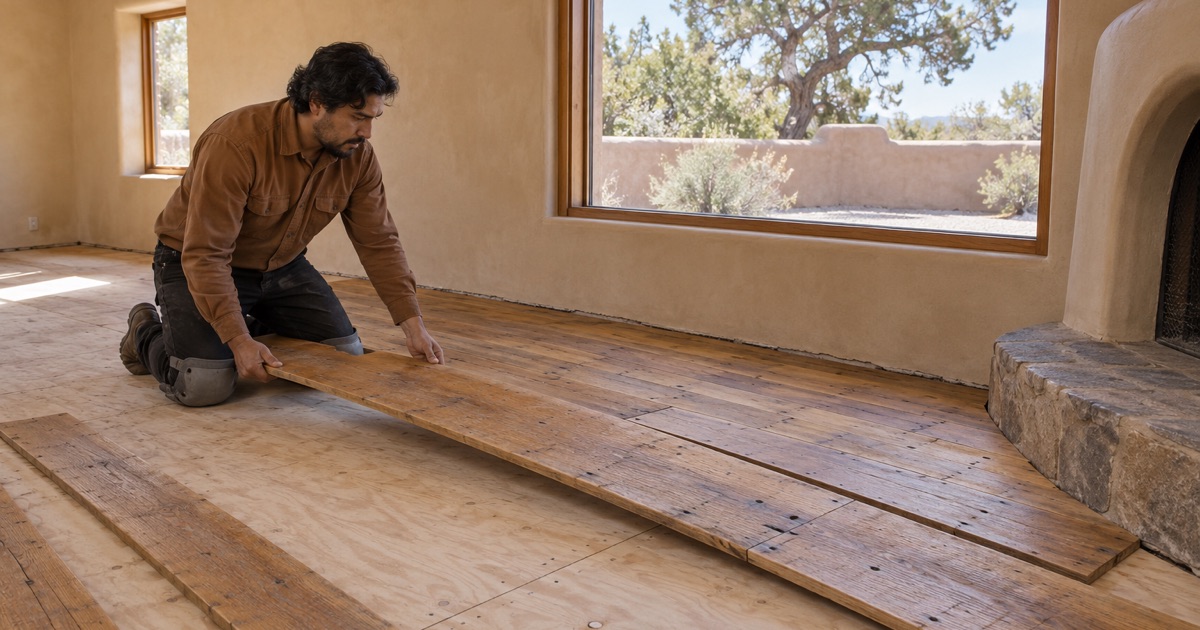
Reclaimed and wide boards are often milled and stored in regions much wetter than a heated house here. Laid straight from the truck, they shrink over the first dry season and open up between every row.
We read their moisture content on delivery and leave them in the house until they fall within range of the subfloor and the room, measuring rather than counting days. Boards that refuse to settle are set aside rather than forced into the floor.
Installing Wide Boards So They Stay Flat
Glue-Assist and Fastening Schedules
Wide solid boards are prone to cupping when fastened with nails alone. A glue-assist, with adhesive applied to the subfloor under each board, reduces movement and holds the board flat. We set nail spacing to the manufacturer’s schedule and the NWFA installation guidelines for the width.
The subfloor has to be flat and firmly fastened before wide boards go down, since a long, wide plank bridges more of any hump or dip than a narrow strip does, and it will rock or squeak where a strip floor would have followed the surface.
Face Screws, Plugs and Expansion Gaps
Some very wide or reclaimed boards are also face-screwed and plugged, which adds hold and becomes part of the look. Every wide plank floor gets a full expansion gap at the walls, because a wide board that has no room to swell in a wet monsoon season will buckle.
- 20+ Years Experience
- Written Moisture Readings
- Itemized Written Estimates