
Santa Fe Wood Flooring handles wood floor refinishing in Santa Fe, NM, serving surrounding cities including Agua Fria, La Cienega, Eldorado at Santa Fe, Valencia and Lamy. With 20+ years spent sanding and finishing hardwood, we take worn, scratched, stained or discolored floors back to clean wood and build a new finish suited to how the rooms get used.
Refinishing is not one job. Some floors need to come down to bare wood; others only need their existing finish abraded and topped with fresh coats. We look at the wear pattern, the species, how much wood is left above the tongue and what finish is already on the boards before deciding, and the recommendation you get is the least work that fixes the problem.
Every refinishing job comes with stain samples laid on your actual boards, finish products that meet federal VOC limits, and a written cure schedule so you know when you can walk on the floor, when furniture goes back and when rugs can return.
Signs a Floor Is Ready for Refinishing
Gray Traffic Lanes and Bare Wood
The first sign is usually a dull, gray path from the front door to the kitchen, where grit has ground through the finish and the wood has started to absorb dirt. Once the finish is gone in those lanes, water and spills soak straight into the boards and stain them.
Caught while the finish is only dull, a traffic lane can be handled with a screen and recoat. Once the wood itself has grayed, a full sand is the only way to bring it back to an even color.
Deep Scratches, Dents and Pet Damage
Surface scuffs live in the finish and disappear in a recoat. Scratches that cut into the wood, dents from dropped pans and claw marks from dogs need sanding deep enough to get below them. Softer species like pine show this damage faster than white oak or hickory, and the Janka hardness rating is a fair guide to how quickly it returns.
Pet urine stains are a separate problem, because they go deeper than scratches. We check how far each stain has penetrated before promising it will sand out, and we quote board replacement where it will not.
Peeling, Cloudy or Sticky Finish
Finish that peels in flakes or sheets usually means a coat was applied over wax, oil soap or a product it could not bond to. Cloudy or white patches point to trapped moisture or a finish that was put down too heavy. A sticky surface can mean a cleaner residue has built up over years.
None of these is fixed by adding another coat on top. We identify what is under the failure, sand past it, and choose a finish that will bond to clean wood.
Sanding Methods for Hardwood Refinishing
Drum Sander, Edger and Grit Sequence
A full refinish starts with a drum sander on the open floor and an edger along the walls, working through a grit sequence from coarse to fine. The coarse pass removes the old finish and the damage; each finer pass removes the scratches left by the one before it.
Skipping grits is the most common shortcut in this trade, and it shows up as swirl marks and chatter once stain or finish goes on. We finish with a multi-disc or orbital sander to blend the field and the edges so the transition along the baseboard does not read as a band.
Dustless Sanding in Lived-In Homes
Our dustless sanding system connects the drum sander, the edger and the buffer to a high-volume vacuum, which captures most of the dust at the sanding head. For families living at home through the work, that is the difference between a manageable week and a house coated in fine wood dust.
We still tape plastic over doorways, close off HVAC returns and cover what cannot move. No vacuum system catches every particle, and the parts of the job done by hand, like corners and stair nosings, still make some dust.
Screen and Recoat Instead of a Full Sand
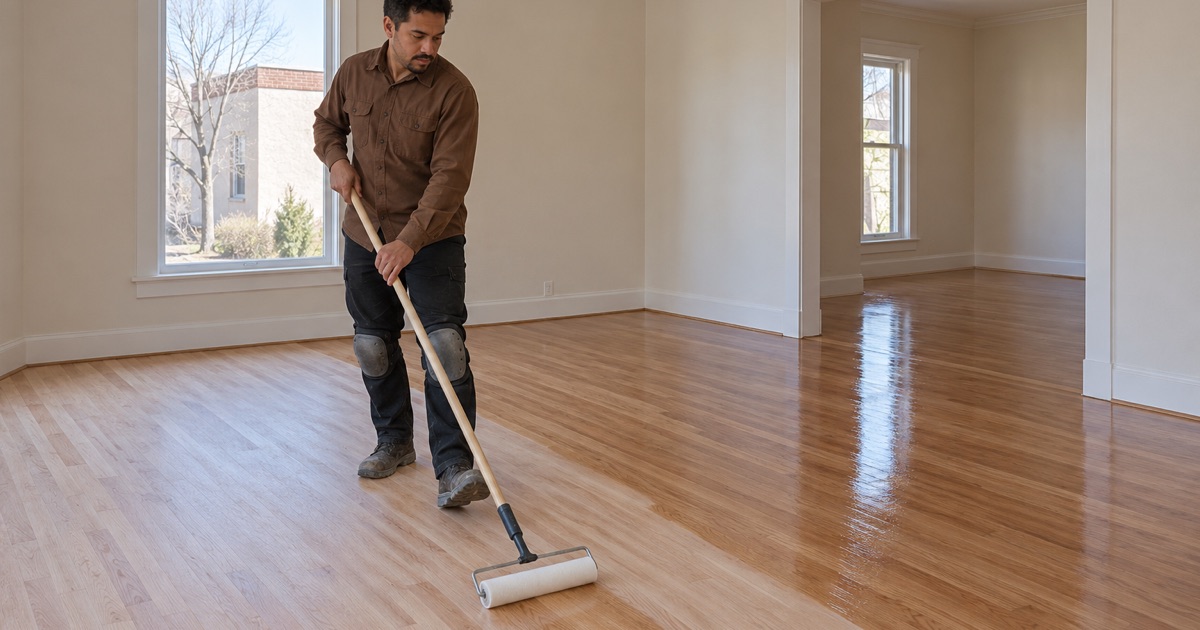
A screen and recoat buffs the existing finish with an abrasive screen, cleans it thoroughly and applies one or two fresh coats. It removes surface scuffs, evens out dullness and adds protection without taking any wood off the floor, which preserves sandings for the future.
It works only on a sound polyurethane finish with no bare wood, no deep scratches and no wax. Floors with a history of wax or silicone-based cleaners often need testing first, because a recoat over contamination peels within weeks.
Stain and Finish Choices for Santa Fe Floors
Stain Color on Red Oak, White Oak and Pine
Red oak carries a pink undertone, white oak reads cooler and more olive, and pine absorbs stain unevenly. The same can of stain can look like three different colors across those species, which is why we lay sample patches on your floor after sanding rather than showing you a printed chart.
Pine and maple are prone to blotchy stain, so we either use a conditioner, choose a gel stain, or recommend a natural finish that lets the wood read as itself. Old red oak that has gone orange loses that cast once sanded, and a neutral or cool stain keeps it from coming back as quickly.
Waterborne, Oil-Modified and Hardwax Oil Finishes
Waterborne polyurethane dries clear, keeps light woods light, has low odor and lets rooms go back into use sooner. Oil-modified polyurethane warms the color toward amber, builds quickly and cures more slowly. A hardwax oil finish soaks into the wood rather than forming a film, so worn areas can be refreshed locally without sanding the whole room.
Every product we use is chosen to meet the architectural coatings VOC limits in 40 CFR 59 Subpart D. For occupied homes and short-term rentals with tight turnarounds, low-odor waterborne systems are usually the practical choice.
Sheen Level and Everyday Wear
Sheen level runs from matte through satin and semi-gloss to gloss. Higher sheens look richer on the day they go down but show every scratch, footprint and speck of grit. Matte and satin hide the fine wear that comes with dust and sand tracked in from gravel drives and dirt yards.
We recommend a sheen by room and traffic, and we can put a lower sheen in hallways and entries and a higher one in a formal room when that suits the house.
Refinishing Older and Occupied Homes
Lead-Safe Refinishing Before 1978
In pre-1978 housing, old paint on baseboards and thresholds, and sometimes old finishes, can contain lead. Sanding turns that into fine dust. We follow lead-safe work practices under the EPA Renovation, Repair and Painting rule on those homes, which the EPA administers directly in New Mexico, and the federal lead dust hazard standard for floors changed on January 12, 2026.
That means containment, HEPA vacuums, careful cleaning and a cleaning check before the rooms go back into use, rather than sanding an old house the same way as a new one.
Refinishing Floors That Move With the Seasons
In a dry climate, the boards may be tighter in late summer and gapped in the middle of winter. We schedule refinishing when we can, check the moisture content of the wood before sanding, and avoid filling gaps that will simply reopen. Filler forced into a seasonal gap cracks out in the first dry spell and leaves a line of loose crumbs.
Where the floor is cupped, we let it dry and flatten before sanding. Sanding a cupped floor flat while it is still wet leaves it crowned once it dries, which is a far harder problem to fix.
Rentals, Listings and Tight Timelines
Short-term rentals, homes about to be listed and units between tenants all need refinishing on a date that holds. We give owners and managers a written cure schedule that shows when light foot traffic, furniture and rugs can go back, and we sequence rooms so the parts of the house that must stay open can be used.
Where the schedule is short and the finish is sound, a recoat will often fit a window that a full sand never could, and we will say so up front rather than squeezing a full job into too few days.
- 20+ Years Experience
- Written Moisture Readings
- Itemized Written Estimates